Okay, let's briefly review what the month of April is going to look like for me.
29 March: fly to Barcelona
02 April: fly to Rome
04 April: fly to Marseilles
07 April: fly back to Rome
08 April: fly back to Barcelona
09 April: return to Cairo; parents arrive in Cairo
12 April: Depart Cairo for Sharm el Sheik
15 April: return to Cairo
24 April: Depart Cairo for Nuweiba by bus (near Dahab)
25 April: ferry to Aqaba, Jordan; bus to Amman, Jordan
26 April: taxi to Deir Debawan, Palestine; Ramallah, Palestine
27 April: cross the checkpoints into Jerusalem
28 April: back to Amman, Jordan; bus to Aqaba, Jordan
29 April: ferry to Nuweiba, Egypt; return to Cairo by bus.
So um...I'm here for school, right?
Wednesday, February 28, 2007

Sunday, February 25, 2007
 Tonight I went to my first open water certification course.
Yeah, that means I'm learning to scuba dive.
Two days in the classroom, some time in a pool, and then we're off to dive the Red Sea this weekend.
We're renting a private 4-level safari boat for as much as a cheap hotel would cost, and spending the night on the sea, diving for two days straight.
We're hitting Hurghada, Sharm (pictured below), and anywhere in between.
I'm getting certified for life.
And the entire thing is going to be about US$300.
Contain yourself.

Saturday, February 24, 2007
Khan el-Khalili Revisited
An (almost) all-picture post in honor of Chris & Kim Obranovich. Hi guys. Miss you.
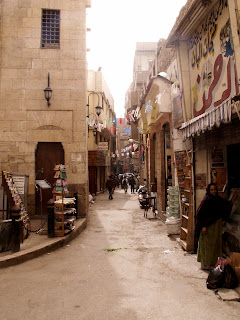 I went back to Khan el-Khalili for a second try, and a better attempt at photography.
 Went back to the al-Azhar Mosque (didn't get ripped off this time).
 This time they were cleaning.
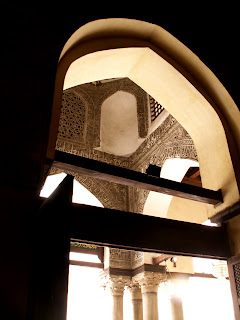 Still pretty, but kind of overcast. The light could have been better.
 The streets around the mosque are pretty quiet.
 This man had the attention of every neighborhood cat. All 13,000 of them.
 Tourism and Antiquities Police. Protecting the world from fake magic lamps.
 No buy just look.
 This is a happy cat.
 This is not a happy cat. It couldn't move. I diagnose distemper.
 Ben found this. Eskimo blanket? It's a little far from home.

 Mad skill.
 Scandal.
 Please read the Engrish. Also, it came with a badass scimitar.
 Hijabi Barbie. Not kidding.
 Probably a good place/time to excavate the sewer.
 FIN.
FIN.
 I went back to Khan el-Khalili for a second try, and a better attempt at photography.
 Went back to the al-Azhar Mosque (didn't get ripped off this time).
 This time they were cleaning.
 Still pretty, but kind of overcast. The light could have been better.
 The streets around the mosque are pretty quiet.
 This man had the attention of every neighborhood cat. All 13,000 of them.
 Tourism and Antiquities Police. Protecting the world from fake magic lamps.
 No buy just look.
 This is a happy cat.
 This is not a happy cat. It couldn't move. I diagnose distemper.
 Ben found this. Eskimo blanket? It's a little far from home.
Spices I get. Dried sea stars? Huh.
 Indigo.
 Blowfish.
 Hussein mosque.
 Indigo.
 Blowfish.
 Hussein mosque.
 Mad skill.
 Scandal.
 Please read the Engrish. Also, it came with a badass scimitar.
 Hijabi Barbie. Not kidding.
 Probably a good place/time to excavate the sewer.
 FIN.
FIN.Friday, February 23, 2007
Insult to Injury
To whoever stole my purse last night at Club Malibu,
I can understand you taking the freshly-withdrawn 300LE from my ID holder. That's about $50, but it can go a long way in Egypt.
300LE is coincidentally the value of the phone you also stole. And I can understand that, too. You could switch out the sim card and sell it. That makes sense.
But did you really have to put it in the trashcan in the bathroom when you were done? They don't sell Lysol wipes here.
Love,
Kari
I can understand you taking the freshly-withdrawn 300LE from my ID holder. That's about $50, but it can go a long way in Egypt.
300LE is coincidentally the value of the phone you also stole. And I can understand that, too. You could switch out the sim card and sell it. That makes sense.
But did you really have to put it in the trashcan in the bathroom when you were done? They don't sell Lysol wipes here.
Love,
Kari
Wednesday, February 21, 2007
Dis-chord
A few days before my iPod broke, I was wandering back to the dorms from the local market, listening to my 4,098 songs on shuffle. On came a song I hadn't heard in a long, long time: 'Tis of Thee, by Ani Difranco. For those of you who don't know her, she's an indie songstress with a haunting voice that calls for social change.
I don't know how I quite ended up with it in my library, as the last time I remember hearing it was the also the first. Listening to 'Tis of Thee was an assignment, actually; it was part of a unit in my English class that focused on music and "lyrics as literature." I was part of a 5-person group given Difranco's song for an impromptu analysis, and after ten minutes in the hall, we had our very by-the-book explanation of what the song meant. But while the song appealed to me musically, something about it felt wrong.
In it she sings:
My country 'tis of thee
To take swings at each other on the talkshow tv
Why don't you just go ahead and turn off the sun
'Cause we'll never live long enough
To undo everything they've done to you
It's a song about American society, poverty, and race relations. During our presentation, I reached for what I thought was wrong. I remember saying that she was couching her plea for unity in terms of 'they' and 'you,' thereby perpetuating the problem and widening the divide.
It was a rushed and hurried assessment, and I wouldn't even remember it today if it weren't for the fact that I carry every day of that class with me. It was a remarkable time in my life: I thought hard, I loved deep, I was filled with excitement and passion for things as simple as the sun, and I wrote creatively for the last time in my life. I was 15. I don't know if that teacher reads this. I hope he does. I made him a promise, once--nulla dies sine linea--and it's damn past time I started keeping it.
I think of Ani Difranco sometimes when I think about that class. Sometimes I even sing her songs idly in the shower. But I hadn't listened to it since past remembrance until last week walking home from the market. I tried to think, what was it that I exactly didn't like about this song? It wasn't the pronoun usage that bothered me anymore. And then I got it:
Fatalism.
She sings about the ills of the inequalities of American society ("they put everyone in jail / except the Cleavers and the Bradys"), racism, smallpox blankets and poverty, and her grand lyrical suggestion is to "turn off the sun" because the situation is past hope.
And that's what really gets me. Nothing grand was ever accomplished through fatalism. No struggle was ever won under white flags. She's given up on not just the manifestation but the idea of
Tonight a group of us went to a panel lecture discussing the recently proposed constitutional amendments here in
It's difficult to really ascertain what all is included in the amendment package pushed by the government. The local media is unreliable, often censored or just plain wrong, and the Internet is almost just as bad. Online, the discussion of the amendments focuses on removing socialist elements of the constitution, and expanding some fiscal powers of the assembly. At the panel tonight, the amendments were described in very different terms: the elimination of political parties with religious affiliation; a statute on who can run for office, limiting it to party leaders, in effect prohibiting independent candidates (the Muslim Brotherhood, banned from participating in Egyptian politics, routinely runs their candidates as independents), and an abolition of presidential term limits.
Unfortunately, the discussion was in Arabic and way over my level of comprehension. I stuck around long enough to listen to a long speech by the representative from the Brotherhood, and the English summary. In between jokes that I didn't understand but left the crowd laughing (I did understand, however: "The world is dominated by two men who think God speaks to them: Bush and Bin Laden."), he argued that banning religion from politics is impossible in Egypt, and pointed to Article 2 of the Egyptian constitution:
"Islam is the Religion of the State. Arabic is its official language, and the principal source of legislation is Islamic Jurisprudence (Sharia)."
He went on to say that the Brotherhood did not advocate a religious state, but a civil state with a religion. There are only two theocracies left in the world, he said:
It was good to hear his opinion, and it is going to be very interesting to be living in
Within the last few days, the Egyptian government has done a wide sweep of arrests focused on Brotherhood members; in total they have detained over 300:
"...the Brotherhood charges that Mubarak — who has held autocratic power for a quarter century — wants to eliminate the sole opposition movement that could challenge his regime if a fair vote were held. The Brotherhood and secular opposition groups accuse the 78-year-old president of trying to ensure his son, Gamal, succeeds him.
The Brotherhood, which has been banned since 1954 banned but runs candidates as independents, made dramatic gains in parliament elections in late 2005, winning a fifth of the legislature's seats."
Read more about it here.
I have a lot to say about these recent developments in
From The Washington Post, The 'Crime' of Blogging in Egypt.
I'll leave it at that. One of my friends here is in a class taught by a professor who enjoyed a similar experience due to his or her published opinion of Egyptian governance. It's not frequent, but it does happen.
Which brings me back to Ani Difranco. The opinions voiced in the song that I found so abhorrent in the United States seem sweet to me here, simply because I know that she, unlike the characters of her music, will never see the inside of a jail for simply adding her voice to the fray. It's what makes baroque music so beautiful: the addition of the atonal makes whole the melody.
We all know this famous phrase, which is often attributed to Voltaire but was actually coined by Beatrice Hall in an attempt to capture Voltaire's spirit, but I'll repeat it anyway:
Je désapprouve ce que vous dites, mais je défendrai à la mort votre droit à le dire.
And never would it mean so much, a French phrase to an American girl in the streets of
'Tis of thee, indeed.
UPDATE: Abdel Kareem Nabil sentenced to four years in prison for his blog.
Tuesday, February 20, 2007
How to Spend your Down Time
If there's one thing I think I'm going to get out of my five months in Egypt, it's how to take it slow.
Egyptians have mastered the art of hanging out: meandering on the sidewalks, lazily engaged in conversation, or slumped in a chair in the sun surrounded by friends between classes. While the traffic is horrendous, no one seems to be in much of a rush; you get there when you get there. Class begins more or less around the same time, after you run into your professor in line for coffee and wander back together.
But given the pace of American life, and my typical schedule at Georgetown, it's weird not to be busy all the time. I don't have a meeting to go to, and there's no GERMS practical on Saturday morning. Just a lot of hanging out.
AUC is a huge high school flashback for me: not only are the courses reminiscent of my adolescence (think reading out of the newspaper, creative writing prompts in class, using course readers with the "difficult words" defined), but the culture of the school is vaguely high school-ish. There are cool kids who gather in cliques based around what label they wear (Prada, Gucci, Fendi, etc.), with specific locations where they sit in between classes. People arrive in the morning and don't go home until late at night. The halls and stairwells are glorified benches. And I really should have a locker for all my books.
And since high school itself wasn't too challenging for me, I filled my time elsewhere. Mostly with Search and Rescue, but I did some other school clubs and volunteer work. So here in Cairo, I knew that if I didn't sign up for something, I'd spend all my time on Facebook and What Would Tyler Durden Do?, and while chronicling Britney Spears' cyclonic descent into madness is all well and good (what's next, Scientology?), I needed to do something worthwhile. Idle hands and whatnot.
So, for the past two weeks I've been tutoring Sudanese refugees at St. Andrew's Church and refugee ministry in Cairo. It serves as a primary school for refugee children during the day, and a learning center for adults in the evenings. I spend Monday nights chatting with adults in English or helping them correct their homework, and Tuesday mornings in a classroom of 8-12 year olds.
So far it's been a lot of fun, and pretty educational for me. The adults all seem to have left Sudan around 2004, and by the grace of the UN, were relocated in Egypt. They are refugees from either southern Sudan (where the Second Sudanese Civil War between the southern Christian/Animists and the northern Muslims killed 1.9 million civilians, the most since World War II) or the Darfur region of western Sudan (where a regional conflict has degenerated into tacitly-sanctioned genocide).
Their English skills vary. Last night, I worked with two young men: one, a 27 year old from Darfur who asked me to speak to him in French, but didn't know French, nor English, so after I tried both we resorted to Arabic; and the other, a very young looking 23 year old from southern Sudan to whom I taught the words "dude" and "bro," as he was well on his way to mastering conversational English. I've tried to talk to them about Sudan, but in all cases their vocabulary is pretty limited. Words like genocide, refugee status, and ethnic cleansing are all pretty foreign, even though they witnessed it first hand. When I ask them why they want to learn English, their answers vary: To get a job, to tell people about my country, to make money, to be educated.
Mussa, a thirtysomething sliver of a man from Darfur, wanted to learn English so that he can go back to his village and make things better for his family and the town. He tried to explain to me what he had seen there, but his accent was so thick and he spoke so quickly in Arabish (that's Arabic + English) that I had a hard time making out what he was saying. I asked him if anyone in his family had been killed. He shrugged and said, "Of course." Had he seen anyone killed? "What do you think? Of course. In the streets." They all have a pretty cavillier attitude towards it, but I think that's the attitude you have to adopt if you're faced head on with the evils of humanity on a daily basis. Suffice to say it breaks my heart, though, to see people--kids, really--my age discuss genocide with a wave of their hand, as if they were talking about the lunch they ate yesterday.
I usually try to stay away from unhappy topics like that. They want to hear all about the US: where I live, what my hobbies are, what music I like, what it's like to live in the United States. I tell them about my weekend, and ask them if they like living in Cairo. The answer is unequivocally no. It's dirty, it's too small, they don't like the food or the people, and when I ask them where they want to go next, the answer is always the same: America.
The children are fun, and they're teaching me more Arabic than I think I'm teaching them English. My friend Jordan and I help out in a classroom taught by a take-no-prisoners woman named Fatima, whose English is really very good. While English is supposed to be the only language spoken in the classroom (which is really just part of a gymnasium divided into sections by screens), most things are clarified by Fatima in Arabic. Amongst themselves, the children speak Arabic without fail. While they dutifully write down everything on the board in English (e.g. "Birds eat nuts and seeds."), their mastery of it is limited to "okay," "teacher!!!," and "excellent," the latter of which when written on a page of homework sends them into convulsions of glee.
I bring a highlighter with me, and draw big colorful stars on their papers. Today they were learning multiplication. I remember back in third grade learning times tables, and I can't imagine doing it in a language not my own. Two times eight can be tricky, but thamania wa thamania usually elicits the correct answer in Arabic: sitta-ashar. Arabic numbers were something I always had trouble with for some reason, and I think today marked the first time that I used them without having to think in English first.
After about an hour of school, it's time for "sport," oft-lamented by Fatima as the only thing they care about. The class gets rowdy around 11:30, with only 1/3 of the students in their seats. The rest are running around begging for recess. Jordan and I like it too, because we get to play soccer with the kids for an hour. Some of them are really quite good, but it reminds me of refereeing 3rd grade soccer where bunch ball was still the name of the game. We definitely have fun running around with the kids, and do our best not to kill any of them with a shot to the head.
I don't know much about the children...where they come from, where they live, what they've seen. They're all amazingly friendly, though, and very polite, and most of them seem to actually enjoy school. I hope they enjoy hanging out and playing with us awkward, big American kids. It sure seems like they do.
In any case, I'm loving my time at St. Andrew's so far. It's rewarding for me, as I've never done any real volunteer work with things that talk back (previously limited to cats, sea life and dead people), and even though we're all limited in what we can say, a round of high fives after I scored my first goal (!) really does go a long way.
And at least it keeps me out of trouble. :)
See the wikipedia entry about St. Andrew's United Church here.
Egyptians have mastered the art of hanging out: meandering on the sidewalks, lazily engaged in conversation, or slumped in a chair in the sun surrounded by friends between classes. While the traffic is horrendous, no one seems to be in much of a rush; you get there when you get there. Class begins more or less around the same time, after you run into your professor in line for coffee and wander back together.
But given the pace of American life, and my typical schedule at Georgetown, it's weird not to be busy all the time. I don't have a meeting to go to, and there's no GERMS practical on Saturday morning. Just a lot of hanging out.
AUC is a huge high school flashback for me: not only are the courses reminiscent of my adolescence (think reading out of the newspaper, creative writing prompts in class, using course readers with the "difficult words" defined), but the culture of the school is vaguely high school-ish. There are cool kids who gather in cliques based around what label they wear (Prada, Gucci, Fendi, etc.), with specific locations where they sit in between classes. People arrive in the morning and don't go home until late at night. The halls and stairwells are glorified benches. And I really should have a locker for all my books.
And since high school itself wasn't too challenging for me, I filled my time elsewhere. Mostly with Search and Rescue, but I did some other school clubs and volunteer work. So here in Cairo, I knew that if I didn't sign up for something, I'd spend all my time on Facebook and What Would Tyler Durden Do?, and while chronicling Britney Spears' cyclonic descent into madness is all well and good (what's next, Scientology?), I needed to do something worthwhile. Idle hands and whatnot.
So, for the past two weeks I've been tutoring Sudanese refugees at St. Andrew's Church and refugee ministry in Cairo. It serves as a primary school for refugee children during the day, and a learning center for adults in the evenings. I spend Monday nights chatting with adults in English or helping them correct their homework, and Tuesday mornings in a classroom of 8-12 year olds.
So far it's been a lot of fun, and pretty educational for me. The adults all seem to have left Sudan around 2004, and by the grace of the UN, were relocated in Egypt. They are refugees from either southern Sudan (where the Second Sudanese Civil War between the southern Christian/Animists and the northern Muslims killed 1.9 million civilians, the most since World War II) or the Darfur region of western Sudan (where a regional conflict has degenerated into tacitly-sanctioned genocide).
Their English skills vary. Last night, I worked with two young men: one, a 27 year old from Darfur who asked me to speak to him in French, but didn't know French, nor English, so after I tried both we resorted to Arabic; and the other, a very young looking 23 year old from southern Sudan to whom I taught the words "dude" and "bro," as he was well on his way to mastering conversational English. I've tried to talk to them about Sudan, but in all cases their vocabulary is pretty limited. Words like genocide, refugee status, and ethnic cleansing are all pretty foreign, even though they witnessed it first hand. When I ask them why they want to learn English, their answers vary: To get a job, to tell people about my country, to make money, to be educated.
Mussa, a thirtysomething sliver of a man from Darfur, wanted to learn English so that he can go back to his village and make things better for his family and the town. He tried to explain to me what he had seen there, but his accent was so thick and he spoke so quickly in Arabish (that's Arabic + English) that I had a hard time making out what he was saying. I asked him if anyone in his family had been killed. He shrugged and said, "Of course." Had he seen anyone killed? "What do you think? Of course. In the streets." They all have a pretty cavillier attitude towards it, but I think that's the attitude you have to adopt if you're faced head on with the evils of humanity on a daily basis. Suffice to say it breaks my heart, though, to see people--kids, really--my age discuss genocide with a wave of their hand, as if they were talking about the lunch they ate yesterday.
I usually try to stay away from unhappy topics like that. They want to hear all about the US: where I live, what my hobbies are, what music I like, what it's like to live in the United States. I tell them about my weekend, and ask them if they like living in Cairo. The answer is unequivocally no. It's dirty, it's too small, they don't like the food or the people, and when I ask them where they want to go next, the answer is always the same: America.
The children are fun, and they're teaching me more Arabic than I think I'm teaching them English. My friend Jordan and I help out in a classroom taught by a take-no-prisoners woman named Fatima, whose English is really very good. While English is supposed to be the only language spoken in the classroom (which is really just part of a gymnasium divided into sections by screens), most things are clarified by Fatima in Arabic. Amongst themselves, the children speak Arabic without fail. While they dutifully write down everything on the board in English (e.g. "Birds eat nuts and seeds."), their mastery of it is limited to "okay," "teacher!!!," and "excellent," the latter of which when written on a page of homework sends them into convulsions of glee.
I bring a highlighter with me, and draw big colorful stars on their papers. Today they were learning multiplication. I remember back in third grade learning times tables, and I can't imagine doing it in a language not my own. Two times eight can be tricky, but thamania wa thamania usually elicits the correct answer in Arabic: sitta-ashar. Arabic numbers were something I always had trouble with for some reason, and I think today marked the first time that I used them without having to think in English first.
After about an hour of school, it's time for "sport," oft-lamented by Fatima as the only thing they care about. The class gets rowdy around 11:30, with only 1/3 of the students in their seats. The rest are running around begging for recess. Jordan and I like it too, because we get to play soccer with the kids for an hour. Some of them are really quite good, but it reminds me of refereeing 3rd grade soccer where bunch ball was still the name of the game. We definitely have fun running around with the kids, and do our best not to kill any of them with a shot to the head.
I don't know much about the children...where they come from, where they live, what they've seen. They're all amazingly friendly, though, and very polite, and most of them seem to actually enjoy school. I hope they enjoy hanging out and playing with us awkward, big American kids. It sure seems like they do.
In any case, I'm loving my time at St. Andrew's so far. It's rewarding for me, as I've never done any real volunteer work with things that talk back (previously limited to cats, sea life and dead people), and even though we're all limited in what we can say, a round of high fives after I scored my first goal (!) really does go a long way.
And at least it keeps me out of trouble. :)
See the wikipedia entry about St. Andrew's United Church here.
Subscribe to:
Posts (Atom)